Building Circularity at Industrial Scale

Building Circularity at Industrial Scale

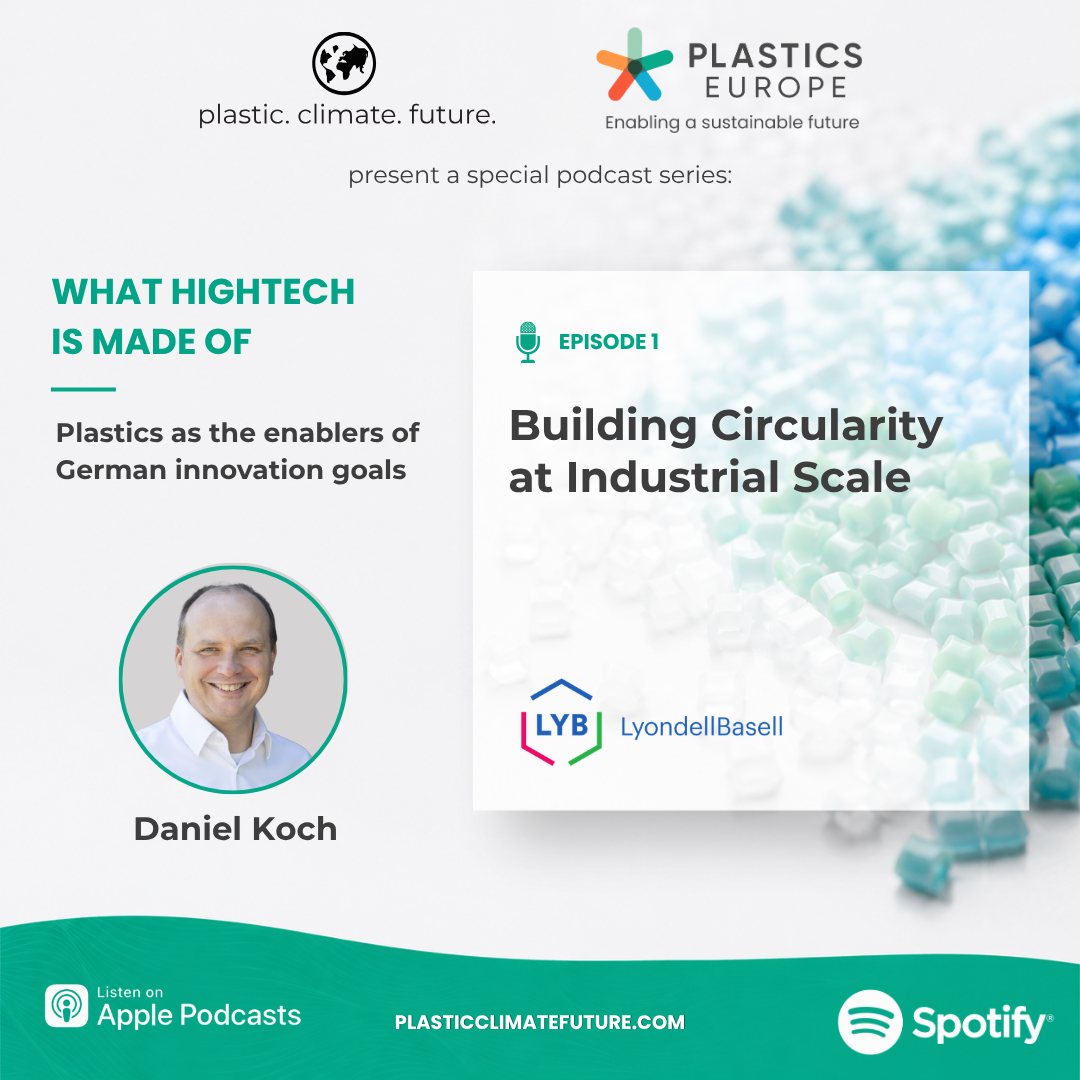
Germany’s future technologies share one common denominator: plastics. In our series with Plastics Europe Deutschland, we talk to the people turning that into solutions — from material volume to material competence, the core idea behind The Plastic Shift.

For our first company conversation, we sit down with Daniel Koch from LyondellBasell to look at what circularity means when it moves beyond the lab and into industrial reality.

At LyondellBasell’s Wesseling site, the company is building its first industrial-scale MoReTec plant, designed to turn difficult-to-recycle mixed plastic waste into feedstock for new polymers.

We talk about what it really takes to bring circularity to industrial scale — from transforming existing production sites and integrating new technologies into established operations, to creating the conditions that allow these investments to succeed. And we explore why the transition will depend not only on new technology, but also on infrastructure, expertise, regulation and demand.

As Daniel puts it:

“Circularity is not really only a technology question.”

And perhaps that is the bigger story: transforming the plastics industry doesn’t necessarily mean starting again from scratch. It can also mean using the infrastructure, expertise and people we already have to build something new.

This is the first episode in our new mini-series exploring the innovative spirit of Germany’s plastics and polymer industry — and the people turning transformation into industrial reality.

🎧 Listen now on Spotify and Apple Podcasts!

Read More
The Next Chapter for Germany’s Plastics Industry

The Next Chapter for Germany’s Plastics Industry

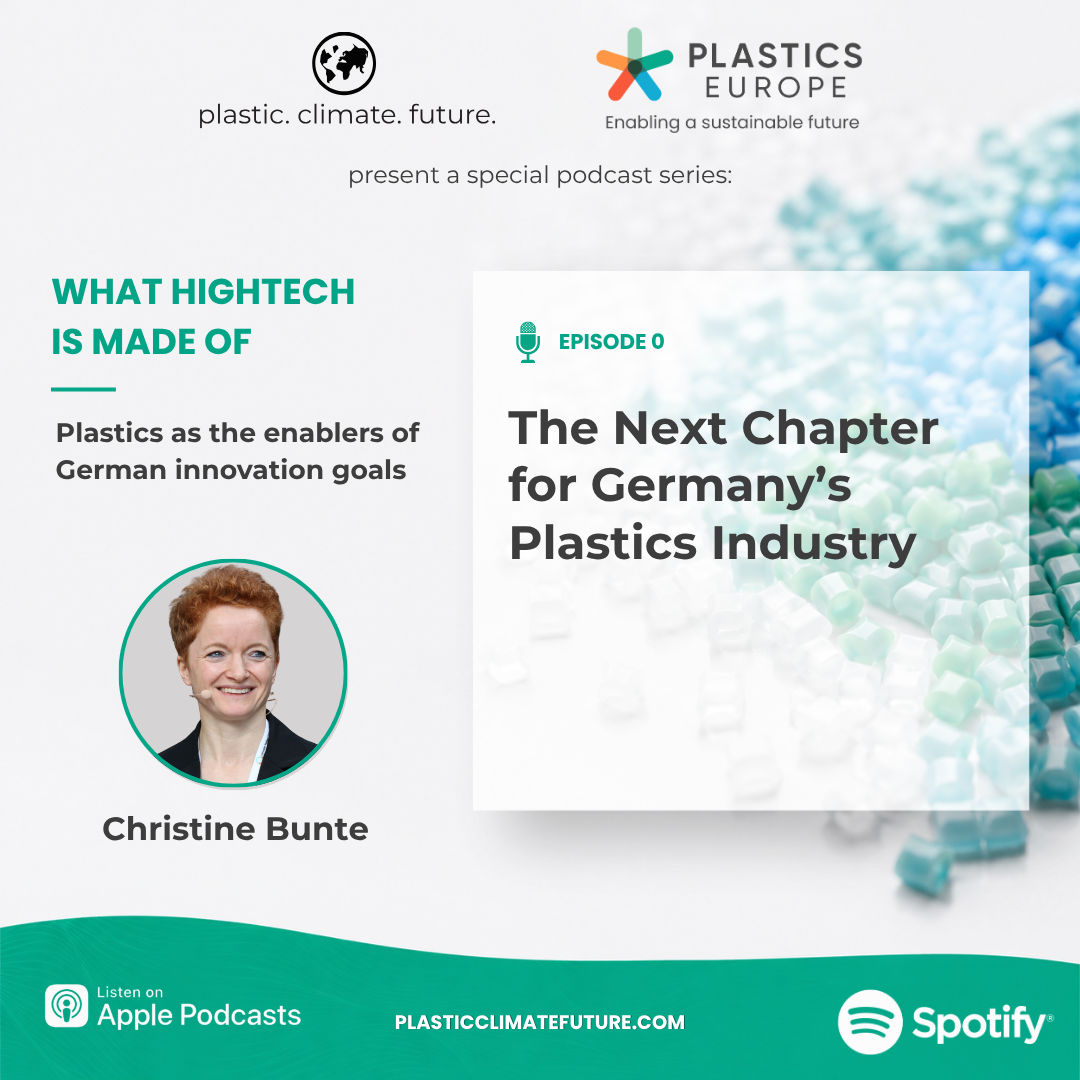
Germany doesn't have an ideas problem.

Eight years of shrinking industrial production. Christine Bunte, Managing Director of Plastics Europe Deutschland, calls it what it is: not an economic dip, but a structural crisis.

And yet — the universities are excellent. The research is excellent. The ideas are there. What's missing is the step from idea to industrial scale.

“We have lost speed in making these ideas industrial products and bringing them to industrial scale. That is often the step that's missing.”

So Plastics Europe Deutschland is turning the perspective around: from material volume to material competence. Plastics not as the villain, but as the invisible key technology behind Germany's future industries.

From today, our series “What Hightech Is Made Of” — following the seven fields of Germany's Hightech-Agenda, with the people actually building the solutions. Every Tuesday and Thursday, through to the innovation press conference in Berlin on 11 September.

Here a short preview of what’s coming:

  • How mixed plastic waste becomes raw material again - at industrial scale, inside a working chemical park. 

  • Why finding the right formulation used to take months and now takes minutes. 

  • What's inside a power cable and why it decides how much wind energy actually arrives.

  • Why no electric car moves without flame retardants. 

🎧 Listen now on Spotify or Apple Podcasts!

Read More

The Plastic That Fades Away, and Ends Up Saving Coral Reefs

The Plastic That Fades Away, and Ends Up Saving Coral Reefs

What started as an effort to create a better alternative to conventional plastic straws led to something nobody expected.

In this episode, we speak with Brad Laporte and Michael Winters from WinCup, the team behind PHADE®—a PHA-based material designed to biodegrade in environments where conventional plastics persist. Along the way, they discovered an entirely unexpected application: helping researchers restore coral reefs by protecting young corals during their most vulnerable stage.

Together, we discuss:

  • How bacteria can produce the next generation of plastics

  • Why they chose PHA over paper straws

  • The surprising connection between biodegradable plastics and coral restoration

  • What it takes to bring a new material from the lab to billions of products

  • Why science, certification, and performance matter in building trust

This is a fascinating conversation about material innovation, unexpected discoveries, and how one idea can solve problems far beyond its original purpose.

🎧 Listen now on Spotify or Apple Podcasts!

Read More

Are Circular Plastics Ready for the Mainstream?

Are Circular Plastics Ready for the Mainstream?

Circular plastics have moved beyond pilot projects. Today, companies are investing in mechanical recycling, chemical recycling, renewable feedstocks, and even CO₂-based materials. But are these solutions ready to scale—and what will it take to make them mainstream?

In this episode, we sit down with Stephan Roest, Head of Circular Economy Business Development at Borouge International. Having spent many years at Borealis, Stephan brings a unique perspective on how the plastics industry is evolving—from linear production towards truly circular value chains.

Together, we discuss:

  • What it takes to scale circular plastics

  • The roles of mechanical and chemical recycling

  • Renewable and alternative carbon feedstocks

  • Why collaboration across the value chain is essential

  • How regulation, innovation, and market demand are shaping the industry's future

This is an insightful conversation about the opportunities (and the challenges) of making circular plastics part of the mainstream.

🎧 Listen now on Spotify or Apple Podcasts!

Read More

Is Seaweed a New Hope for Sustainable Packaging?

Is Seaweed a New Hope for Sustainable Packaging?

In this episode, we speak with Neil Morris, founder of Kelpi, about how seaweed-based materials could help reshape the future of packaging — and what it really takes to move beyond fossil-based plastics.

We discuss:

  • Why seaweed is attracting attention as a renewable feedstock

  • The challenge of scaling sustainable packaging solutions

  • How brands are approaching next-generation materials

  • The realities behind replacing conventional plastics

  • Why infrastructure, economics, and regulation matter as much as innovation

What makes this conversation especially interesting is that it moves beyond hype. Neil shares the practical realities of building a materials startup in one of the world’s most challenging industries — packaging.

At Plastic Climate Future, we believe serious conversations about plastics, climate, circularity, and innovation need nuance, not slogans.

🎧 Listen now on Spotify or Apple Podcasts!

Read More

Is Plastic Recycling in Europe Really Broken?

Is Plastic Recycling in Europe Really Broken?

What if the problem isn’t that we’re failing to recycle, but that the system itself is working against it?

In this episode, we speak with Joan Marc Simon, founder of Zero Waste Europe and one of the leading voices shaping circular economy policy across the EU. With decades of experience bridging grassroots action and European regulation, he brings a sharp and often uncomfortable perspective on what’s really happening behind the scenes of plastic recycling.

Note: This conversation was recorded prior to recent developments in the Middle East impacting global oil and plastics markets.

From oversupply and global market dynamics to policy design and economic realities, this conversation challenges some of the most widely held assumptions about circularity.

𝗪𝗵𝗮𝘁 𝘄𝗲 𝗲𝘅𝗽𝗹𝗼𝗿𝗲:

  • Why plastic recycling in Europe is struggling — despite ambitious targets

  • How global oversupply is undermining local circular systems

  • The role of policy, economics, and unintended consequences

  • Whether we need to rethink not just recycling, but plastic production itself

A thought-provoking conversation that goes beyond the surface — and asks whether we’re solving the right problem at all.

🎧 Listen now on Spotify or Apple Podcasts!

Read More

Can Design Thinking Change the Future of Plastics?

Can Design Thinking Change the Future of Plastics?

What if the future of plastics doesn’t start in a lab, but in a design studio?

In this episode of Plastic. Climate. Future., we speak with Beat Karrer, founder of FluidSolids, who took an unconventional path from industrial design into material innovation — developing high-performance materials made entirely from waste streams.

From corn cobs to coffee waste, his work challenges a fundamental assumption: that plastics must come from fossil resources.

We explore:

  • How waste streams can become high-performance material feedstock

  • Why design thinking is a powerful (and often overlooked) driver of material innovation

  • What it takes to scale new materials — from pilot to industrial production

  • Why circularity depends on systems, not just materials

A refreshing and grounded perspective on what it really takes to rethink plastics, not just replace them.

🎧 Listen now on Spotify or Apple Podcasts!

Read More

Electrifying the Future: Can Power Drive Circularity?

Electrifying the Future: Can Power Drive Circularity?

Circularity isn’t just about materials. It’s about energy.

In this episode of Plastic. Climate. Future., we speak with Constantine Lau from Schneider Electric, who is leading electrification strategies for some of the world’s most energy-intensive industries.

With decades of experience across oil, gas, and chemicals, Constantine shares why the shift from managing molecules to managing electrons may be one of the most underestimated levers for circular transformation.

We explore:

  • Why electrification is central to scaling circular systems

  • How digitalization and energy management reshape industrial operations

  • The connection between decarbonization and circularity

  • Why ROI and regulatory clarity must align for real impact

A strategic, forward-looking conversation about how energy systems and circular systems are more connected than we often think.

🎧 Listen now on Spotify or Apple Podcasts!

Read More

Are Enzymes the Missing Link in Plastics Circularity?

Are Enzymes the Missing Link in Plastics Circularity?

What if the breakthrough in plastic recycling doesn’t come from higher temperatures or bigger reactors — but from biology?

In this episode of Plastic. Climate. Future., we speak with Oliver Borek from Entzimatiko, a company developing a novel enzymatic technology that goes beyond conventional chemical recycling.

Their approach combines enzyme engineering, nano-encapsulation, and oxidation in a single-step process — operating at ambient conditions and targeting even the toughest materials, including polyolefins.

We explore:

  • Why polyolefins have long been considered “uncrackable” — and what may be changing

  • How enzymatic machinery differs from pyrolysis and hydrothermal methods

  • What low-temperature, solvent-free processing could mean for cost and scalability

  • Why competitiveness with fossil equivalents is critical for real impact

  • The roadmap to commercial scale by 2030

A fascinating conversation about science, risk, and what it takes to move breakthrough technology from lab to market.

If circularity is to scale, innovation must go beyond incremental change. This episode dives into what that could look like.

🎧 Listen now on Spotify or Apple Podcasts!

Read More

The Packaging Puzzle: Will Digital Twins Bring Us Closer to Circularity?

The Packaging Puzzle: Will Digital Twins Bring Us Closer to Circularity?

🎙️ A new chapter begins.

We’re kicking off the next series of Plastic. Climate. Future. —𝐓𝐨𝐰𝐚𝐫𝐝𝐬 𝐚 𝐂𝐢𝐫𝐜𝐮𝐥𝐚𝐫 𝐅𝐮𝐭𝐮𝐫𝐞 — a 12-month journey exploring the innovations, systems, and people shaping a circular plastics economy.

𝐄𝐩𝐢𝐬𝐨𝐝𝐞 𝟏: 𝗧𝗵𝗲 𝗣𝗮𝗰𝗸𝗮𝗴𝗶𝗻𝗴 𝗣𝘂𝘇𝘇𝗹𝗲: 𝗪𝗶𝗹𝗹 𝗗𝗶𝗴𝗶𝘁𝗮𝗹 𝗧𝘄𝗶𝗻𝘀 𝗕𝗿𝗶𝗻𝗴 𝗨𝘀 𝗖𝗹𝗼𝘀𝗲𝗿 𝘁𝗼 𝗖𝗶𝗿𝗰𝘂𝗹𝗮𝗿𝗶𝘁𝘆?

We kick things off by tackling a major roadblock on the path to circularity: packaging systems that lack transparency, traceability, and integration.

Our guests — Valeria Masci and Ignacio Fernández-Pacheco Ruiz from the MAGNO project — share how advanced modeling and data tools are helping map packaging flows, identify inefficiencies, and design solutions that actually work at scale.

𝗪𝗲 𝗲𝘅𝗽𝗹𝗼𝗿𝗲:

  • Why packaging data is fragmented — and how digital twins could help

  • What it takes to trace, model, and redesign circular flows

  • How collaboration across brands, suppliers, and policymakers is both the challenge and the opportunity

A forward-looking start to a year of ideas that move us from ambition to action.

🎧 Listen now on Spotify or Apple Podcasts!

Read More