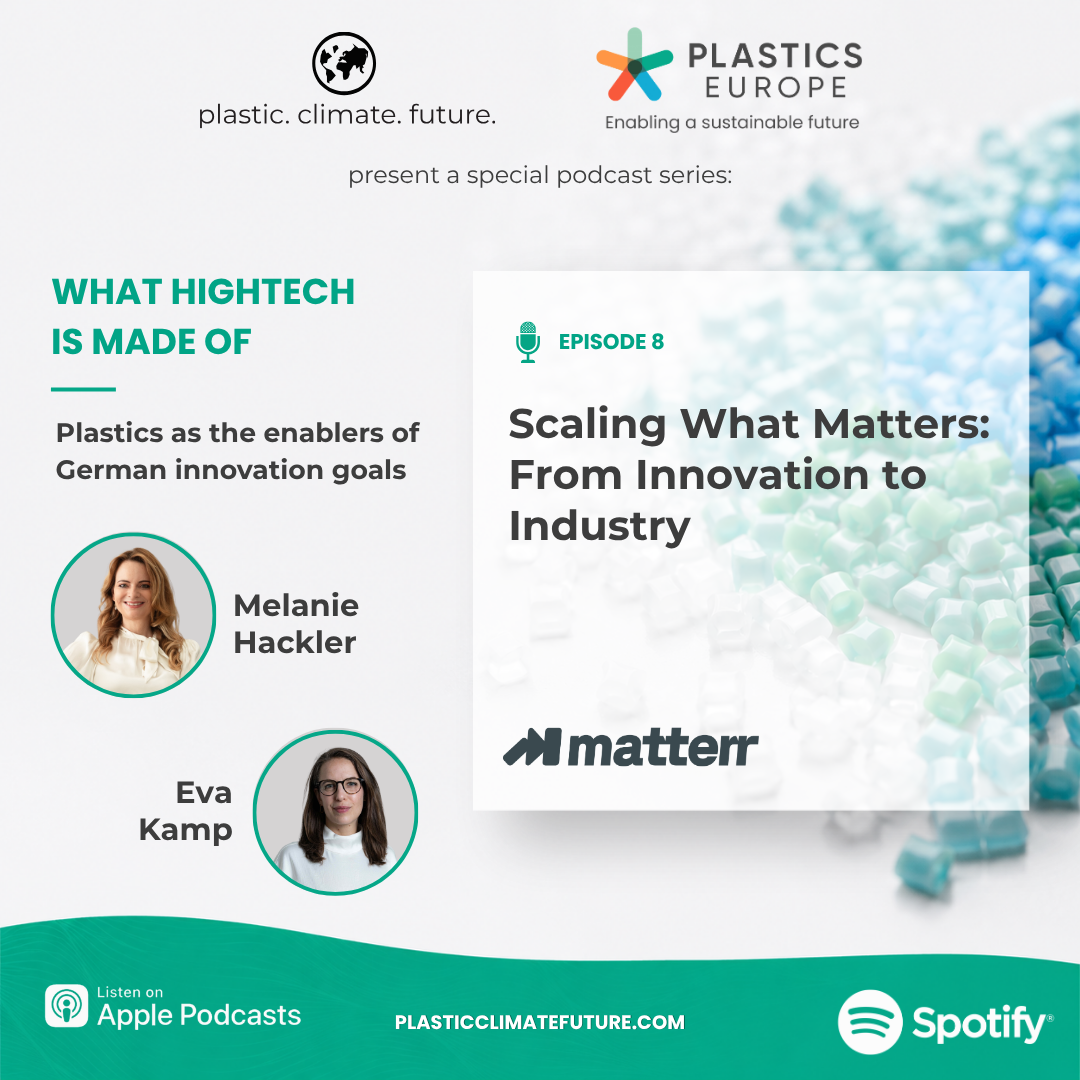
Last week in Berlin, Germany’s innovation ambitions took center stage. Our series with Plastics Europe Deutschland continues with another example of the technologies and companies shaping its industrial future.
We speak with Melanie Hackler and Eva Kamp from matterr about what happens after you develop a promising recycling technology: how do you actually scale it into an industrial business?
matterr has developed a chemical recycling process that breaks polyester-rich waste back down into its original building blocks. Those recycled monomers can then be used again in existing polyester production — turning waste into a new raw material.
But technology alone doesn’t create a circular economy. Scaling requires reliable waste streams, sorting infrastructure, customers, investment and an ecosystem capable of bringing all of those pieces together.
We discuss:
How matterr’s technology tackles complex polyester waste that conventional recycling struggles with
What it takes to move from a pilot plant to industrial scaleWhy circular materials have to compete with linear production systems optimized over decades — and the role regulation and investment can play in enabling the transition
Why Germany’s infrastructure, expertise and industrial ecosystem can provide a strong foundation for scaling the next generation of circular technologies
The technology is there. The need is clear. The challenge is taking circular solutions from promising innovations to competitive industrial scale.
Because for circular technologies to matterr, they have to scale.
🎧 Listen now on Spotify and Apple Podcasts!